External scanner cameras represent one of the most significant advancements in poker analyzer system architecture. While integrated scanners — built into phone-style analyzer housings — remain effective for many applications, external cameras dramatically expand the operational flexibility of poker analyzer systems. For B2B buyers evaluating scanner options, understanding the capabilities, limitations, and deployment scenarios of external cameras is essential. This article provides a comprehensive technical overview of external scanner camera technology and its role in modern poker analyzer systems.
The Case for External Scanners
Integrated scanner cameras, concealed within analyzer housings, are limited by fundamental physical constraints. The lens must be small enough to remain hidden, the focal distance is fixed by the housing geometry, and the scanning angle is determined by how the user holds the device. These limitations become problematic in certain gaming scenarios.
External scanners solve three core problems: barcode poker analyzer.
First, they enable distance scanning. Integrated cameras typically read marked cards effectively within a 30 to 60 centimeter range. External cameras with appropriate lenses can read marks from distances exceeding 2 meters, opening up scenarios where the analyzer operator is not seated immediately adjacent to the card deck.
Second, they provide angle flexibility. An external camera can be positioned independently of the analyzer unit, allowing optimal lens orientation relative to the card surface. This is particularly valuable in games where cards are dealt at unusual angles or where table layout restricts direct overhead viewing.

Third, they offer form factor diversity. Because the scanner is separate from the analyzer, it can be disguised as virtually any common object — a button, a key fob, a beverage container, a wall fixture. This separation dramatically reduces the visual profile of the analyzer system.
Types of External Scanner Cameras
The external scanner market offers numerous form factors, each designed for specific deployment scenarios. Understanding the strengths and limitations of each type helps B2B buyers assemble versatile scanner kits.
Button and Cufflink Cameras
Among the most popular external scanners, button cameras are designed to replace standard clothing buttons on shirts, jackets, or vests. The lens is micro-scoped — typically 2 to 4 millimeters in diameter — and positioned to scan cards on a table surface from a natural seated position.
Key advantages include extremely low visual profile, natural body placement that avoids suspicion, and compatibility with virtually any poker analyzer model. Limitations include relatively short scanning range (typically 25 to 45 centimeters) and dependence on the wearer maintaining appropriate posture.
Cufflink cameras operate on similar principles but offer slightly different positioning geometry. They are less common but can be valuable in scenarios where button placement is suboptimal.
Car Key and Key Fob Cameras
Disguised as automotive key remotes, these scanners can be placed on a table surface — on a keychain or lanyard — providing a stable scanning platform. The key fob form factor is universally unremarkable in casual settings, making it an excellent choice for environments where electronic devices might attract attention.
Scanning range typically extends to 60 to 80 centimeters, and the stable table placement eliminates the micro-movements that can affect body-worn cameras. Some models include built-in wireless transmitters, eliminating the need for visible wiring between scanner and analyzer.
Beverage Container Cameras
Water bottles, coffee cups, and energy drink cans can be modified to house scanner cameras with remarkable effectiveness. The container sits naturally on a gaming table, and the camera lens — positioned near the base or through a label — reads cards from a fixed, stable position.
These scanners excel in long-session scenarios where the container remains stationary throughout gameplay. The scanning angle is determined by container placement, which can be optimized before play begins. Range typically reaches 50 to 70 centimeters, depending on lens specifications.
Power Bank and Electronic Device Cameras
Power banks, mobile chargers, and similar electronic accessories represent another category of external scanners. These items are expected to sit on tables and are universally accepted in modern environments. A power bank scanner can house a larger battery — supporting extended operation — and a higher-quality lens than smaller form factors.
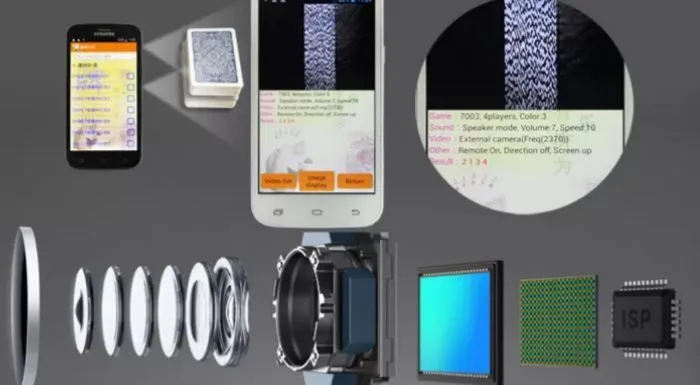
Advantages include extended battery life (often 8+ hours of continuous operation), larger lens apertures for improved low-light performance, and the ability to house wireless transmission hardware without spatial constraints.
Ceiling and Wall-Mounted Cameras
For fixed-installation scenarios, ceiling and wall-mounted scanners provide the ultimate in scanning range and stability. These cameras are typically installed in lighting fixtures, smoke detectors, decorative elements, or structural features above or adjacent to the gaming table.
Scanning distances can reach 3 meters or more with appropriate lens configurations. The fixed positioning allows precise calibration, and the elevated perspective often provides a clear view of card faces even when cards are held at angles that defeat table-level scanners. These installations require more setup time but deliver superior performance for permanent gaming environments.
Wireless Transmission Technology
The effectiveness of an external scanner depends heavily on the quality of its data transmission to the analyzer unit. Modern external cameras use several transmission technologies, each with distinct characteristics.
2.4 GHz wireless is the most common transmission method. It offers a good balance of range, reliability, and power consumption. Top-tier scanners use frequency-hopping spread spectrum (FHSS) technology to minimize interference from other 2.4 GHz devices. Effective range typically extends to 10 meters indoors.
5.8 GHz wireless provides higher bandwidth and less interference congestion than 2.4 GHz, making it suitable for environments with dense wireless traffic. The trade-off is shorter effective range — typically 5 to 7 meters — and higher power consumption.
Wired connections remain relevant for scenarios where wireless transmission is impractical or where maximum reliability is required. Thin, flexible cables can be routed through clothing or furniture to connect external scanners directly to the analyzer. Wired connections eliminate interference risk entirely and provide the lowest latency of any connection method.
Lens Specifications and Performance Factors
The lens is the most critical component of any external scanner camera. Several specifications determine scanning performance:
Focal length determines the optimal scanning distance. Short focal length lenses (3-6mm) work best for close-range body-worn scanners, while longer focal lengths (8-25mm) suit distance and ceiling-mounted applications. Some premium scanners offer adjustable focal lengths, though these require more careful calibration.
Aperture size affects low-light performance. Larger apertures (smaller f-numbers) allow more light to reach the sensor, improving scan reliability in dimly lit environments. However, larger apertures require larger lens housings, which can compromise disguise effectiveness Pokercheat8 Casino Equipment.
Sensor resolution must be sufficient to resolve the fine detail in marked cards. Most quality scanners use sensors with 1080p or higher resolution. Higher resolution sensors provide better detail capture but consume more power and generate more transmission data.
Infrared sensitivity is essential for scanners designed to read infrared-marked cards. The sensor must include an IR-pass filter and adequate IR sensitivity to detect marks invisible to the naked eye. Not all external scanners include IR capability, so buyers should confirm this specification if IR card compatibility is required.
Power Management and Battery Life
External scanner battery life directly impacts operational effectiveness. A scanner that fails mid-session is worse than no scanner at all.
Body-worn scanners typically use small lithium-polymer batteries rated for 2 to 4 hours of continuous operation. The compact form factor limits battery size, making power management critical. Top-tier models include automatic power-saving modes that reduce consumption when no cards are being scanned.
Table-placed scanners (key fobs, containers, power banks) can accommodate larger batteries, often delivering 6 to 12 hours of operation. Some models support hot-swappable batteries, allowing continuous operation through extended sessions.
Fixed installations draw power from building electrical systems, eliminating battery concerns entirely. However, these installations should include uninterruptible power supply (UPS) backup to prevent scanning interruptions during power fluctuations.
Compatibility Considerations
Not all external scanners are compatible with all poker analyzer models. B2B buyers must verify compatibility across several dimensions:
Protocol compatibility: The scanner must use a transmission protocol that the analyzer can receive. Leading analyzer manufacturers typically support proprietary wireless protocols in addition to standard formats. Scanners from the same manufacturer as the analyzer generally offer the most reliable integration.
Connector compatibility: For wired scanners, the physical connector must match the analyzer’s input port. Common formats include micro-USB, USB-C, and proprietary multi-pin connectors.
Software recognition: The analyzer’s software must be able to identify and configure the external scanner. Some analyzers support automatic scanner detection, while others require manual configuration through the setup menu.
Deployment Best Practices
Maximizing external scanner effectiveness requires attention to deployment details:
Pre-session calibration is essential. Before live use, operators should test the scanner with actual marked cards at the intended distance and angle. Lighting conditions should be evaluated — insufficient or uneven lighting can significantly degrade scanning accuracy.
Redundant scanner deployment is advisable for critical applications. Running two scanners simultaneously — one body-worn and one table-placed — provides fallback capability if one scanner experiences interference or battery failure.
Regular maintenance keeps scanners performing optimally. Lens surfaces should be cleaned with appropriate optical cleaning materials, battery contacts should be inspected for corrosion, and wireless transmission range should be periodically tested to detect antenna degradation.
FAQ
What is the maximum effective range of an external scanner camera?
Distance depends on lens specifications and form factor. Body-worn scanners typically operate within 25 to 60 centimeters. Table-placed scanners can reach 60 to 80 centimeters. Ceiling and wall-mounted cameras can scan from distances exceeding 3 meters. Buyers should select scanners based on the specific distances required by their operational scenarios.
Can multiple external scanners be used simultaneously with one analyzer?
Many top-tier analyzers support dual or even multiple scanner inputs, allowing simultaneous use of body-worn and table-placed cameras. This redundancy improves scanning reliability and provides fallback capability. However, not all analyzers offer this feature, so compatibility should be confirmed before purchasing multiple scanners.
How does ambient lighting affect external scanner performance?
Insufficient lighting reduces sensor input and can cause scanning errors or missed reads. Direct sunlight can create lens flare that obscures card marks. Ideal lighting is diffuse, even, and moderately bright — typical of indoor gaming environments. Some premium scanners include automatic exposure adjustment to compensate for varying light conditions.
Are external scanners compatible with all types of marked cards?
Most external scanners can read standard barcode-marked and infrared-marked cards. However, scanner sensitivity varies, and some marks require specific sensor capabilities — particularly IR-sensitive sensors for infrared marks. Buyers should specify which card marking systems they intend to use and verify scanner compatibility accordingly.
How long do external scanner batteries typically last?
Battery life ranges from 2 hours for compact body-worn scanners to 12+ hours for table-placed units with larger batteries. Fixed installations with continuous power eliminate battery limitations. Operators should plan for battery replacement or recharging during extended sessions, and having charged spare batteries available is strongly recommended.
What maintenance do external scanner cameras require?
Lens cleaning is the most frequent maintenance task — use only optical-grade cleaning materials to avoid scratching. Battery contacts should be inspected periodically for oxidation. Wireless antennas in body-worn units can degrade over time due to flex stress, so transmission range should be tested regularly. Cables on wired scanners should be checked for insulation damage at connection points.
Conclusion
External scanner cameras transform poker analyzer systems from single-configuration tools into versatile platforms adaptable to diverse gaming environments. The ability to select from multiple form factors — each optimized for specific distances, angles, and disguise requirements — gives operators unprecedented tactical flexibility. For B2B buyers, the key to building effective scanner kits lies in understanding operational requirements, verifying analyzer compatibility, and investing in quality hardware that delivers consistent performance. By prioritizing lens quality, transmission reliability, and power management, procurement professionals can assemble external scanner inventories that enhance the value of their overall poker analyzer offerings.